
Build a business that works by design.
Family businesses are shaped by more than strategy and structure. They're shaped by the people, relationships, and ways of working that develop over time.
Our approach brings intention to all of it—helping you understand what to preserve, what to clarify, and what to build next.

A system built for family business.
Six connected components shape how a family business operates, how its people lead, and what carries forward. Together, they create clarity around the decisions, responsibilities, and practices that support the business.
IDENTITY
Who are we?
History, purpose, family influence, strengths, patterns, and what should remain true as the business evolves.
DIRECTION
Where are we going?
Strategic priorities, ownership expectations, vision, and alignment around what comes next.
STRUCTURE
Who owns that?
Roles, authority, decision rights, organizational design, and governance.
STANDARDS
What does good look like here?
Expectations, leadership behaviors, accountability, performance, and family employment standards.
RHYTHM
How do we operate?
Meetings, communication, decisions, feedback, planning, and operating cadence.
CONTINUITY
How does this continue beyond us?
Succession, next-generation development, institutional knowledge, ownership transition, and leadership capacity.

The questions every family business eventually faces.
Some questions emerge through growth. Others surface during transitions, changes in leadership, or simply when familiar ways of working need greater clarity.
The important thing is making space to answer them intentionally.
Who decides?
Who leads?
What’s expected?
How are family members held accountable?
What belongs to ownership versus management?
Who carries the business next?

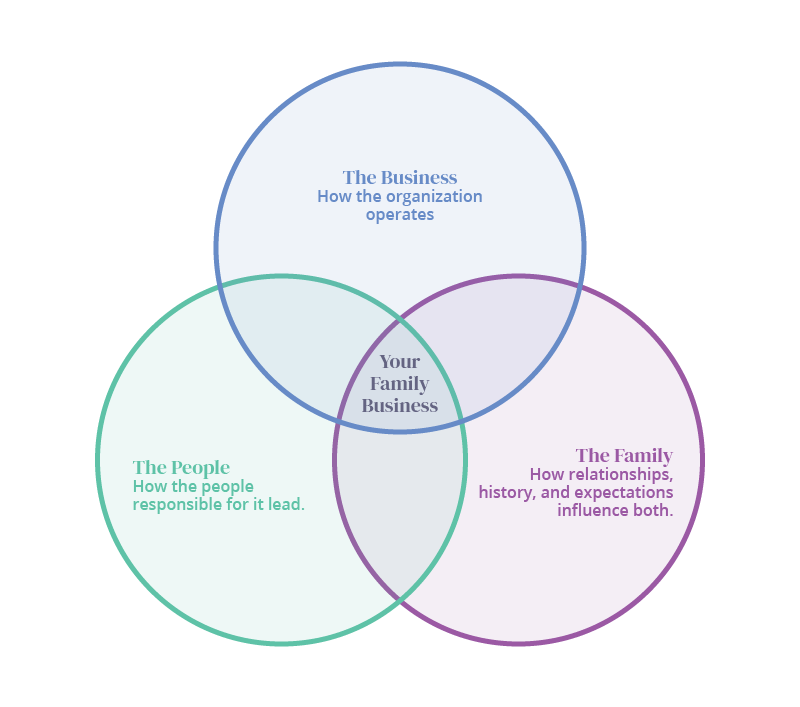
The business is only part of the system.
The operating system doesn't exist independently of the people inside it.
Every part of a family business is influenced by people and relationships: family history, identity, loyalty, expectations, power, conflict, generational patterns, individual behavior, and leadership capacity.
Some of these dynamics are tremendous strengths. Others may become harder to navigate as the business grows. The work considers what should be preserved, what needs greater clarity, and what may need to evolve.
Start with what's happening.
Every family business has its own history, strengths, and ambitions. Whether you're navigating a transition, developing leaders, or reconsidering how the business operates, we start by understanding where you are and what comes next.
-
As the business grows more complex, informal processes, overlapping responsibilities, and inconsistent decision-making can begin to limit its effectiveness.
Sounds like:
“We've grown into a bigger business, but we haven't changed how we run it.” -
When family relationships and business responsibilities overlap, expectations can become unclear, authority gets complicated, and accountability can feel personal.
Sounds like:
“How do I hold my brother accountable without ruining Thanksgiving?” -
Preparing the next generation requires more than developing their skills. It means building confidence, transferring authority, and creating space for emerging leaders to lead—while helping established leaders evolve their own roles.
Sounds like:
“They're ready for more responsibility. Are we ready to give it?” -
Successful transitions require more than identifying a successor. They require clarity around future leadership, ownership, decision-making, and the systems needed to keep the business strong through change.
Sounds like:
“We all know a transition is coming. We just haven't talked about it.” -
The knowledge, instincts, and decisions that helped the founder build the business can also make it difficult to operate without them. Creating clarity, distributing authority, and developing other leaders allows the business to thrive without relying on one person.
Sounds like:
“Every decision still comes back to me.”
NOT SURE WHERE TO START?
Understand before you build.
The Family Business Organizational Health Assessment gives you a clear, candid view of your organization through the eyes of the people who make it work. No additional commitment required.
Understand the family. Architect the business. Protect both.
Every engagement is shaped around what the business needs. Most move through four stages.
Discover
Understand the family, the business, and the existing system: what's happening, what matters, what's working, and where greater clarity may be needed.
Design
Decide what to keep, clarify, or redesign. Determine what should be preserved, what needs to evolve, and what should become more explicit.
Install
Put new roles, standards, and rhythms to work, and build the leadership capacity required for what comes next.
Steward
Establish the practices and rhythms that help changes take hold, and evolve the system as the business and family change.
LEADERSHIP + COACHING
Leadership gets harder as the stakes get higher.
Beyond family business work, Lead for Culture partners with executives, leaders, and teams to develop the internal capacity and external behaviors they need to navigate pressure, complexity, relationships, and responsibility.
Inwardly Sound. Others Focused.

Build what the business needs next.
You don't need to know exactly what kind of support you need. Tell us what has changed and what feels harder than it should. We'll start there.